Guide
Data room vs Google Drive: when a shared folder stops being enough
Google Drive works for early investor updates. Here is where it stops being enough, and what a data room adds when a round or a sale gets serious.
Johannes WithPublished · 5 min read
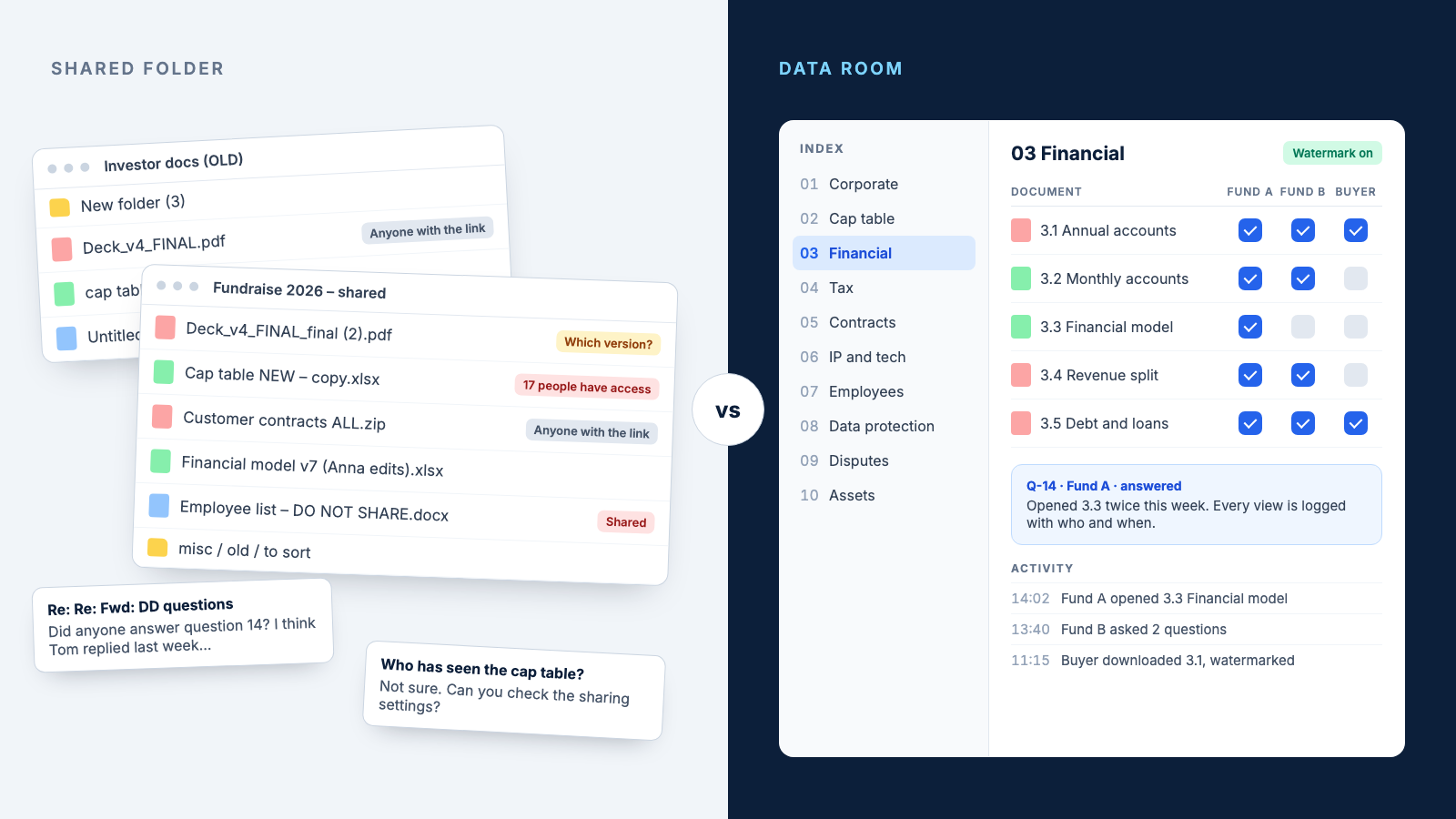
Most founders start a fundraise, or the sale of their SaaS company, with a Google Drive folder, and for a while that is the right call. It is free, everyone knows how it works, and an investor or buyer can open it in one click. The trouble starts when the deal gets serious: more people ask for access, the documents get more sensitive, and you realise you cannot tell who is reading what.
The short answer
This guide covers where Drive works, where it breaks, and how to tell when it is time to move to a data room.
Use Google Drive while you are sharing a deck and a handful of non-sensitive files with people you already trust. Move to a data room when any of these becomes true:
- Several outside parties need access, each to different files.
- You are sharing contracts, the cap table, employee data or customer lists.
- You want to know which investors or buyers are engaged.
- Questions from the other side arrive by email and get lost.
- An adviser, a lawyer or the buyer asks for a proper data room.
What Google Drive does well
Drive is a good tool for the early part of a process. It costs nothing extra, your files are probably there already, and nobody needs instructions. For a pre-seed round with five angels and a deck, a tidy Drive folder is enough, and a data room would be overkill. The same goes for a first conversation with a possible buyer of your SaaS company: a deck and a summary of your metrics do not need one either.
It is also a fine place to prepare. Collecting documents, fixing file names and spotting gaps is internal work, and Drive handles internal work well.
Where Google Drive falls short in a deal
| What a deal needs | Google Drive | A data room |
|---|---|---|
| Access per party | Google DriveSharing by file and folder; hard to audit as folders multiply | A data roomGroups per investor or bidder, with one view of who sees what |
| Leak protection | Google DriveCan block download, print and copy for viewers; no per-viewer watermark | A data roomDynamic watermark that puts the viewer’s identity on every page |
| Engagement | Google DriveView history is limited and built for teams, not outside parties | A data roomActivity per party and per document |
| Questions and answers | Google DriveEmail threads and comments | A data roomA Q&A log tied to the documents |
| Structure | Google DriveWhatever folders you created | A data roomAn index that reviewers recognise |
| Record after closing | Google DriveHard to reconstruct | A data roomA full log of what was disclosed, to whom and when |
Permissions get messy fast
One investor should see the financial model, another should not see customer contracts yet, and the buyer’s lawyers need everything except employee data. In Drive, that means sharing folder by folder and hoping nobody inherits access they should not have. Three weeks in, few teams can say with confidence who can open what.
You cannot see who is serious
In a fundraise or a sale, attention is information. An investor or buyer who has read the financials twice and opened the customer contracts is in a different place from one who looked at the deck once. Drive gives you very little of this for people outside your organisation, so you follow up blind.
A forwarded link is a leak
A link set to “anyone with the link” travels. Restricting it to named accounts helps, but nothing on the page shows who was viewing it when a screenshot was taken. A watermark with the viewer’s name does not make leaks impossible. It makes them traceable, which is usually enough to prevent them.
Q&A lives in email
Due diligence produces dozens or hundreds of questions. In a Drive-based process they arrive by email, get answered by different people, and nobody has the full list. The same question gets answered twice, sometimes differently.
The record matters after the deal
In an M&A transaction, what the seller disclosed in the data room often matters long after signing, because it shapes what the buyer can later claim. A data room keeps a fixed record of every document and every access. A Drive folder that people kept editing does not.
How to tell it is time to switch
A simple test: if you had to answer “who has seen our cap table?” in under a minute, could you? If not, the process has outgrown a shared folder.
The other common trigger is external. Once a lead investor’s lawyers or a buyer’s advisers are involved, they expect an indexed room with a Q&A process, and arriving with a Drive link slows everything down.
Moving from Drive to a data room with Closva
Switching does not mean starting again. In Closva you can:
- Bring your files in from Google Drive, OneDrive, SharePoint or Dropbox, and let the AI sort them into a due diligence structure.
- Set access per buyer or investor, with two-factor verification, dynamic watermarking and a full activity log.
- See which parties are engaged, so you know where to spend your time.
- Run Q&A inside the room, next to the documents the questions are about.
- Keep your data in the EU. Documents are stored on EU servers, and the built-in AI runs in a closed environment in Sweden and never trains on your data.
You can prepare a data room free for 60 days with no card, and you pay only when you open the room to buyers.
Frequently asked questions
Is Google Drive secure enough for a data room?
Drive is secure as storage. What it lacks is deal-specific control: per-viewer watermarks, activity tracking for outside parties, structured Q&A and a fixed disclosure record.
Do I need a data room for a seed round?
Not always. For a small round with investors you know, a well-organised folder works. Once you have institutional investors, legal due diligence or more than a few parties, a data room saves time and looks more professional.
Do I need a data room to sell a SaaS company?
In practice, yes. A buyer will want recurring revenue and churn figures, customer contracts, IP assignments and details of the code and infrastructure, and its advisers expect an indexed room with a Q&A process.
How long does it take to move from Drive to a data room?
For a typical startup, an afternoon. Most of the time goes into checking that documents are complete and current, which you would need to do anyway.
What does a data room cost?
Self-serve tools start at under €100 a month, and enterprise platforms run to five figures a year. See Closva pricing.